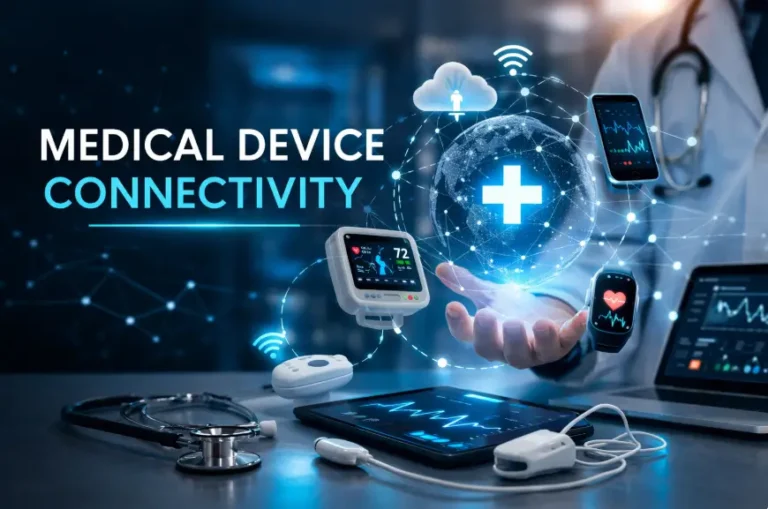
Walk through any hospital floor and you will notice something immediately. Machines are everywhere. Patient monitors track heartbeats and oxygen levels. Infusion pumps deliver medication with precise dosing. Ventilators support patients who cannot breathe on their own. Every one of these devices produces valuable patient data every second.
Yet in many hospitals, that data still follows an outdated path. A nurse reads numbers from a screen and types them later into the EHR. It slows care, invites mistakes, and wastes clinical time. Medical device connectivity fixes that gap. When devices connect directly to hospital systems, patient data moves automatically into clinical records. Clinicians see accurate information instantly, and staff spend less time on documentation.
For healthcare leaders planning their technology strategy, the conversation has shifted. The real challenge today is no longer whether devices should connect. It is how to integrate them safely, efficiently, and at scale.
What Is Medical Device Connectivity?
Medical device connectivity refers to linking clinical equipment with healthcare information systems so patient data can move automatically between them. Instead of staff manually entering readings, devices send information directly to the hospital’s electronic health record. When this connection exists, data travels quickly and accurately through the hospital network. A bedside monitor captures heart rate and oxygen saturation, and that information appears instantly in the patients digital chart.
Hospitals rely on many types of devices that benefit from this connection, including:
- Bedside patient monitors
- Infusion pumps
- ECG machines
- Ventilators
- Imaging equipment
Each device becomes part of a connected digital environment that supports clinicians in making faster and more informed decisions. While the idea sounds simple, the technology required to make these systems communicate reliably is far more complex.
Why Hospitals Are Investing in Device Connectivity
Hospitals do not introduce new technology just to keep up with trends. Most digital initiatives begin with a practical problem that needs solving.
Medical device connectivity addresses several long-standing challenges inside healthcare environments.
Manual documentation is one of the biggest. Nurses often record vital signs multiple times during a shift. Automated device integration removes this repetitive task, giving clinical staff more time to focus on patients. Accuracy improves as well. Even skilled professionals can make mistakes when copying numbers between systems. Direct device integration sends precise readings into the record, reducing the chance of incorrect values appearing in patient charts. Another major advantage is real-time visibility. When device data updates continuously, clinicians can recognize changes in patient conditions much earlier. Faster access to accurate information often leads to quicker treatment decisions.
These improvements may seem incremental at first. Over time, however, they reshape how clinical teams manage patient care.
How Medical Device Connectivity Works
Behind every connected device sits a small but powerful architecture. The process usually follows a structured flow across several systems.
| Stage | What Happens | Why It Matters |
|---|---|---|
| Medical Device | Equipment records patient data | Vital signs, infusion data, and diagnostics originate here |
| Device Gateway | Converts device signals into digital formats | Allows older devices to communicate with networks |
| Integration Engine | Routes and organizes device data | Ensures information reaches the correct clinical systems |
| Electronic Health Record (EHR) | Data appears inside patient charts | Clinicians access accurate real-time information |
This layered structure keeps hospital systems organized. Without gateways and integration engines, most medical devices would never communicate with software platforms.
Standards That Allow Devices to Communicate
Hospitals rely on interoperability standards to make connectivity possible. Without these standards, every device manufacturer would speak a different digital language.
HL7 messaging forms the backbone of many healthcare integrations. It allows clinical systems to exchange structured patient data across applications. FHIR APIs represent the modern evolution of healthcare interoperability. They make data exchange faster and easier for cloud-based platforms and digital health applications. Imaging departments rely on DICOM standards to transmit medical images between equipment and hospital systems.
Many device manufacturers also support IEEE 11073, a framework that standardizes physiological data communication. Together these standards ensure that devices, software platforms, and hospital networks understand one another.
Real-World Use Cases Hospitals Are Deploying
Device connectivity delivers its greatest value when integrated into real clinical workflows. Hospitals across the world already rely on connected tools in several environments.
Intensive care units generate enormous streams of patient data. Connected monitoring systems automatically record vital signs into the patient’s chart, eliminating repetitive manual documentation. Medication delivery also benefits from integration. Smart infusion pumps can transmit dosage and infusion details directly into electronic records, improving medication safety and tracking.
Remote monitoring programs have expanded rapidly in recent years. Patients recovering at home may use connected blood pressure monitors or glucose sensors that transmit readings to clinical teams. Tele-ICU programs represent another growing example. Specialists monitor critically ill patients across multiple hospitals using centralized dashboards fed by connected tools.
The Challenges Hospitals Must Solve
Connectivity offers major benefits, but it also introduces technical challenges. Many hospitals still operate equipment purchased long before modern networking standards existed.
Legacy tools often lack built-in connectivity features. Hospitals must use adapters or middleware to integrate them into current systems. Device manufacturers may also use proprietary communication protocols. Integration teams must translate those protocols into standard formats before data reaches hospital systems. Cybersecurity for protecting connected devices presents another concern. Every connected tools becomes a potential entry point into the network. Healthcare organizations must protect clinical systems through strong authentication, monitoring, and network segmentation.
Despite these hurdles, hospitals that approach connectivity strategically achieve strong long-term gains.
How Hospitals Implement Medical Device Connectivity
Successful implementations rarely happen overnight. Most health systems follow a structured process that reduces disruption to clinical operations.
The first step involves auditing existing tools. Hospitals identify which equipment already supports connectivity and which requires upgrades. Integration platforms are then selected to manage device communication. These platforms normalize data and route it to electronic health record systems. Implementation teams map device data fields to clinical records. This step ensures that patient measurements appear correctly inside the EHR. Testing follows. Engineers verify that the tool transmits accurate information under real operating conditions. Once reliability is confirmed, hospitals roll out the system unit by unit.
Gradual deployment helps clinical teams adapt while IT teams monitor performance.
Cost and Return on Investment
Medical device connectivity requires meaningful investment. Integration platforms, infrastructure upgrades, and implementation services all contribute to project cost.
Small deployments may cost hundreds of thousands of dollars. Large hospital networks implementing enterprise connectivity may spend several million. Yet hospitals rarely evaluate the investment in isolation. Automation reduces documentation time, improves data accuracy, and supports new digital care models.When clinicians gain immediate access to reliable patient data, the operational benefits compound quickly.
Choosing the Right Technology Partner
Device connectivity involves more than connecting hardware to a network. It requires a deep understanding of healthcare workflows, interoperability standards, and security requirements. Healthcare organizations often work with specialized IT partners who understand both clinical environments and infrastructure architecture. One example is Gateway Tech IT Services, a provider focused on healthcare IT consulting and system integration. Organizations like this help hospitals design secure networks, integrate medical tools with clinical systems, and maintain ongoing infrastructure support.
The right partner ensures connectivity projects align with broader digital transformation strategies instead of becoming isolated technical experiments.
FAQs
The Internet of Medical Things refers to networks of connected medical devices that collect and transmit patient health data. These devices include hospital equipment, wearable sensors, and home monitoring tools.
Devices typically connect through gateways and integration engines that translate device signals into standardized healthcare data formats used by electronic health records.
Many older devices require adapters or middleware before they can connect to hospital networks. Some hospitals also upgrade equipment to support modern standards.
Connected monitors, smart infusion pumps, wearable sensors, telemedicine platforms, and remote imaging devices. They transmit patient data automatically, improving accuracy, efficiency, and real-time monitoring.
ISO 13485 ensures quality management in device manufacturing.
IEC 60601 sets safety standards for medical electrical equipment. Together, they guarantee safe and reliable devices.
Bedside monitors, infusion pumps, ventilators, wearable sensors, and imaging machines. They automate data capture and give clinicians real-time, accurate patient information.
Class I: Low-risk (bandages), Class II: Moderate-risk (pumps), Class III: High-risk (pacemakers), Class IV: Life-supporting/complex systems. Classification dictates regulatory and safety requirements.
Conclusion
Healthcare produces an enormous amount of data every day. Medical devices capture vital patient information constantly, yet much of that data remains trapped inside individual machines. Medical device connectivity changes that. When devices communicate directly with hospital systems, patient information becomes accessible in real time. Clinicians can respond faster, documentation becomes easier, and healthcare organizations gain a clearer picture of patient health.
For hospitals building modern digital infrastructure, device connectivity is no longer an optional upgrade. It is a foundation for smarter, data-driven healthcare.